|
|
Warning: This page is seriously out of date!!!
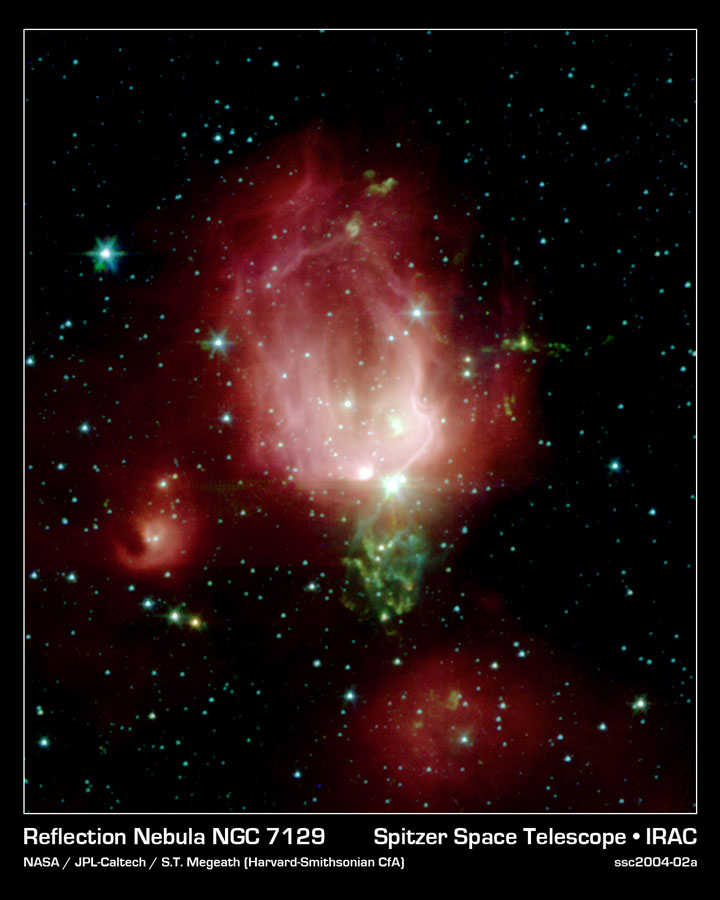
The youngest population of stars in our galaxy is found toward molecular clouds. These stars are thought be a few million years old at most. In many molecular clouds, the detection of protostars in the infrared and submillimeter shows that star formation is ongoing. Young stars are rarely, if ever, found in true isolation. Instead, we find stars form in systems, ranging from groups of a few stars to clusters containing 1000 stars. The nearest 1 kpc contains at least 63 young stellar groups and clusters with more than 10 known stars ( Porras 2003). The goal of the Young Stellar Cluster Survey is to observe the nearest young stellar groups and cluster with the Spitzer Space Obervatory. This is a guaranteed time program of the IRAC instrument team. We selected these regions to have at least 10 known stars, and to have detectable C18O emission (see FCRAO survey below). A total of 31 clusters will be observed. An additional 12 clusters fall within the Orion Survey, and one more young stellar cluster will be observed in a program to study disk evolution from 1 to 100 Myr (both of these are guaranteed time observations obtained through a collaboration of the IRAC and MIPS instrument teams). A total of 44 young stellar clusters will be surveyed with the IRAC and MIPS cameras, providing photometry in five mid-infrared bands. By observing a range of cluster sizes from small groups of of 10 stars to large clusters with 300 stars, we hope to learn how the properties of molecular cloud dictate the properties of the group/cluster that form inside them, and how the group/cluster environment affects the evolution of circumstellar disks and the formation of planetary systems.
The young stellar cluster survey is a collaboration between Phil Myers (CfA), Lori Allen (CfA), Judy Pipher (Rochester) and myself. Rob Gutermuth, a graduate student at the University of Rochester, is using a sample of nine clusters for his thesis work. In advance of the Spitzer Observations, we have been obtaining as many ground based observations as possible. Near-infrared data, particulary JHK-band imaging is a very high priority. Using near-IR data we obtained from the MMT with the Flamingos camera, Rob Gutermuth has already investigated the spatial distribution in three clusters Rob presented a poster describing his results at the Atlanta 2004 meeting.
We have also been busy mapping the molecular clouds in which these clouds are forming. Naomi Ridge (CfA) observed 27 of the regions visible from the northern hemisphere using the FCRAO with the new OTF mapping mode. Tom Wilson (ESO) also observed 17. The combined FCRAO and HHT maps are shown in Naomi's paper . Finally, John Williams obtained SCUBA maps toward four regions.
What Spitzer brings to this program is mid-IR photometry. While near-IR observations can readily detect embedded stars, the near-IR luminosity is typically dominated by the photospheres of young stars. In the mid-IR, emission from circumstellar disks and envelopes begins to dominate, and by studying the combined near-IR and mid-IR colors, we can identify stars with disks and protostars. With the combined near-IR/Spitzer data, we will have eight bands ranging from 1 to 24 microns. We are currently investigating how those colors depend on disk properties and the evolutionary state of the object.
|
|