PHYS 1750: SELECTED TOPICS in PHYSICS
LECTURE 44. Nuclear Physics
Mass units are often expressed in atomic mass units u
= 1.6605 x10⁻²⁷ kg,
= mass of 12C /12.
Since mass is also equivalent to energy through E = mc2,
It is also useful to think of masses in energy units.
For nuclear problems, the MeV (mega electronVolt)
= 1.60 x10⁻¹³ J, is convenient.
1 u is equivalent to 931.5 MeV.
| 29.3. | Atomic Nuclei | ||
| 1. | Atomic number Z and charge | ||
| 2. | Neutron number N | ||
| 3. | Mass number A = N+Z and mass | ||
| 4. | Liquid drop model: r = 1.2A1/3 fm (femtometers = 10-15m) | ||
| 29.4. | Decay Processes | ||
| 1. | Alpha decay (strong force) | ||
| 2. | Beta decay (weak force) | ||
| a. Electrons and positrons | |||
| b. Neutrinos | |||
| 3. | Gamma decay (EM force) | ||
| 29.5. | Radioactivity | ||
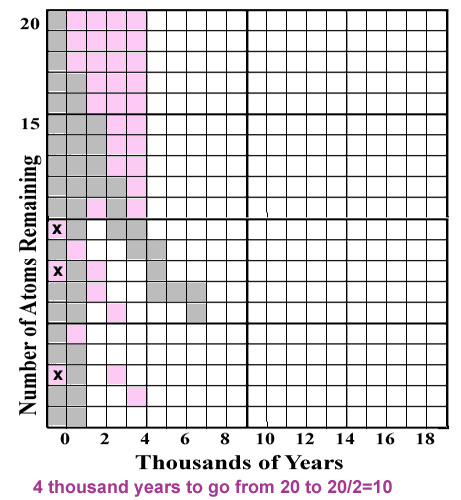
| 1. | Half-lives and rates N = Noe−λ t, where λ = 0.693 / t1/2 Rate of decay = λN = 0.693 N / t1/2 atoms/sec. | ||
| 2. | Radioactive age dating | ||
| 29.6. | Binding Energy | ||
Review Questions for Lectures 44 and 45
Lecture 45: Nuclear Imaging, Fusion, and Fission